
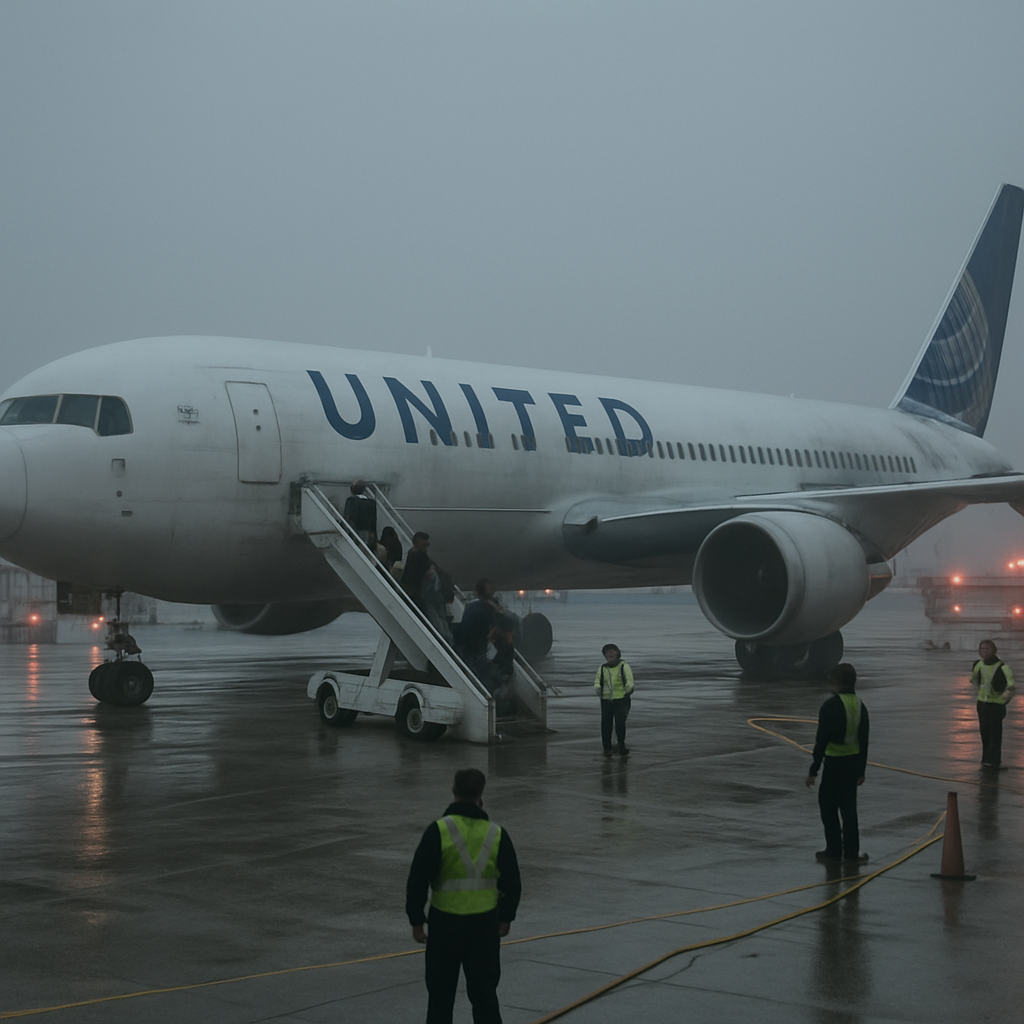
United Airlines Flight UA236 returned to Newark Liberty International Airport on May 30, 2026 after an in-flight security alert disrupted the transatlantic trip to Palma de Mallorca.
The Boeing 767-400 set transponder squawk 7700 and the crew declared a general emergency, prompting a turnaround over the North Atlantic and a full response chain on arrival.
Emergency declaration and transponder squawk 7700 on the NewarkPalma route
The flight operates as a seasonal transatlantic service between Newark Liberty (EWR) and Palma de Mallorca (PMI). The crew s decision to declare a general emergency is paired with the aircraft setting its transponder to squawk 7700, a code described as triggering priority handling and emergency response procedures for air traffic in the aircraft s vicinity.
The operational aim described in the incident sequence was an immediate return to a suitable airport, with Newark selected for its security capabilities and access for rapid emergency response. As the aircraft descended toward Newark, it coordinated with air traffic controllers for sequencing and a safe landing.
Passenger handling after the return: remote stand, bus transport, TSA re-screening
After landing at Newark, the aircraft was met by airport security, TSA officers, and law enforcement personnel. Instead of taxiing to a conventional gate, it was positioned on a remote stand so authorities could manage the situation securely.
Passengers disembarked using mobile stairways onto buses to reach the terminal while airport security maintained perimeter control. All passengers then underwent full TSA re-screening, including carry-on items and personal electronics, and the incident led to passengers being deplaned, re-screened, and delayed in continuing to Mallorca.
Where the alert came from: a reportedly broadcast Bluetooth network name
The security trigger described here is not a confirmed technical incident report, but a situation reportedly linked to a portable Bluetooth device onboard that broadcast a network name and was misinterpreted as a potential threat. Cabin crew reportedly issued repeated announcements instructing passengers to disable Bluetooth devices.
The article also states that no official confirmation had been released by United Airlines or the FAA regarding the Bluetooth device itself. In parallel, the same source describes airline and FAA-driven authority over in-flight safety decisions, including the ability for pilots to take measures necessary to protect passengers and crew, such as returning to the departure airport.
Irregular-operations outcome: rebooking, refunds, and continued seasonal scheduling
Following the return to Newark and completion of security screening, passengers were offered rebooking, refunds, or accommodations consistent with United Airlines policies and U.S. Department of Transportation rules for irregular operations. The flight was scheduled to continue its seasonal service between Newark and Palma de Mallorca once operational clearance and security procedures were complete.
The account frames the event as a test of layered aviation safety involving airline policies, federal air traffic control procedures, and TSA security measures, with mid-flight returns described as rareparticularly when the trigger is framed as a personal electronic device.