
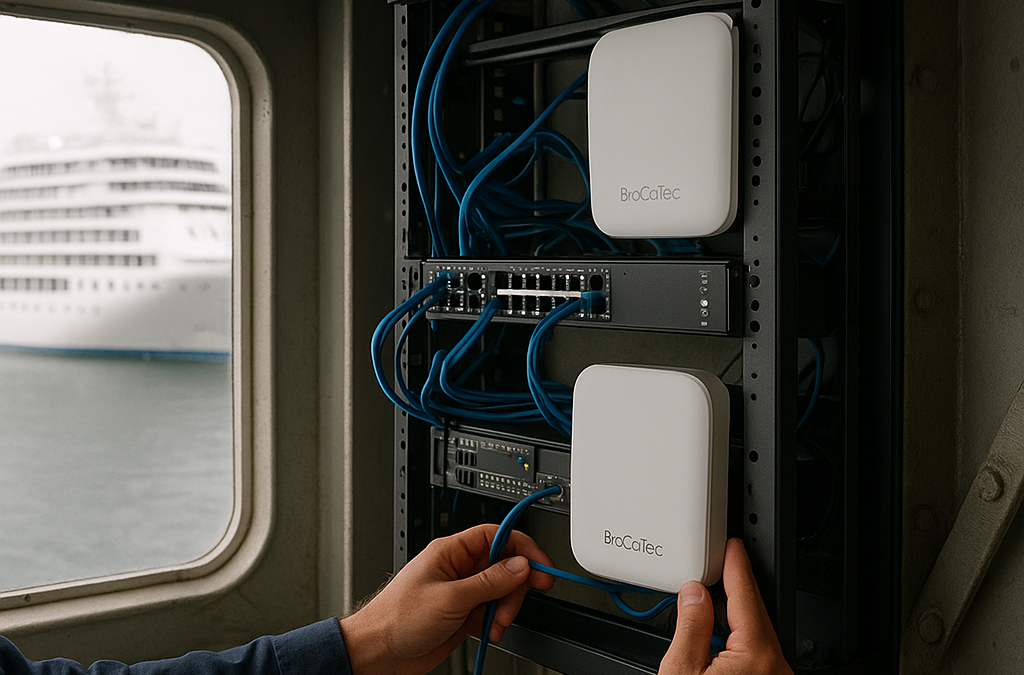
BroCoTec plans to extend beyond its current U.S. waterways footprint, with upcoming work that includes full network and Wi-Fi infrastructure deployment aboard a 600-berth mini-cruise ship. The company’s first maritime client was Encore Dredging Partners (via www.marinelink.com).
BroCoTec says it monitors 100% of Encore Dredging Partners’ fleet IT.
Encore’s dredging fleet is the first maritime test case
Encore Dredging Partners operates cutter suction dredgers across Central U.S. river systems and the Gulf Coast. BroCoTec says it built an office-like onboard environment with Teams, SharePoint and IP phones while keeping IT and OT networks separated.
BroCoTec says crew members now have full Wi-Fi, cellular-over-Wi-Fi calling and dedicated guest networks for personal use. That setup also extends to workboats, crewboats, barges and remote pump stations miles from the vessels’ routes.
Security controls sit alongside connectivity upgrades
Encore Dredging Partners says integrated high-speed network infrastructure, 1080p HD live-feed camera arrays and centralized operational dashboards provide real-time visibility into vessel metrics, environmental data and equipment performance. The company says those connected systems reduce downtime, improve fuel efficiency, improve crew coordination and reduce safety incidents.
BroCoTec says it uses AI analytics to predict component failures such as bearing issues before they cause downtime.
Regulation is now part of the operating model
Kemberling said the U.S. Coast Guard’s 33 CFR Part 101, Subpart F requires strict network segmentation separating business IT from critical OT. He said enforcement of that regulation is set for July 2027.
Kemberling also said cheaper satellite internet such as Starlink has made maritime cybersecurity harder by connecting more onboard devices and exposing operational technology. He said many operators are running 15-year-old PLCs that have not been updated and have major vulnerabilities.
BroCoTec’s next project raises the same problem set at larger scale
The upcoming mini-cruise ship project adds a larger vessel to the same mix of network design, segmentation and coverage work. Kemberling said the ship’s steel superstructure will create unique signal challenges.
For maritime IT teams, the split between guest connectivity and critical OT is no longer theoretical. The claims here show one vendor trying to package that split as a managed service across dredgers, support vessels and a passenger ship build.
Droam Perspective
For maritime IT and fleet technology buyers, the main signal here is that cybersecurity is being sold and delivered as part of the network build, not as a later overlay. BroCoTec’s Encore work shows that package on dredgers and support assets, while the planned mini-cruise ship deployment suggests the same model is being pushed into a larger passenger vessel.
The Coast Guard rule adds a fixed compliance deadline to that operating model, and BroCoTec is already tying its service scope to segmentation between IT and OT. The practical issue for buyers is less about whether connectivity can be added than whether it can be added without flattening the ship’s network into one exposed environment.