
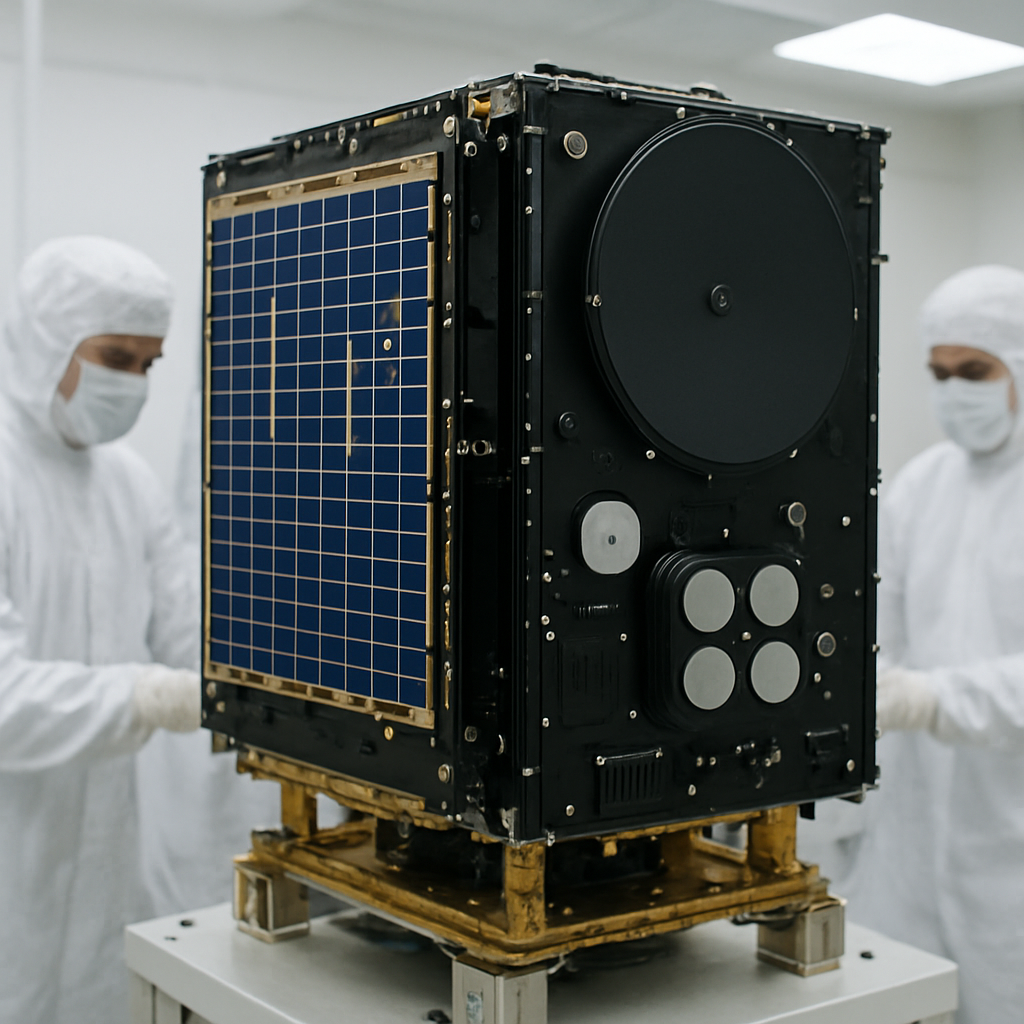
Open Cosmos, based in the United Kingdom, is facing a 2028 deadline to field a broadband constellation for Europe. The program, ConnectedCosmos, is designed to pair secure connectivity with Earth observation and deliver IoT sensing and near-real-time information without relying as heavily on undersea cables and Earth-based hubs.
In an interview with SpaceNews, CEO Rafel Jorda Siquier said Open Cosmos has already launched the first two ConnectedCosmos satellites in January on a dedicated rocket, and is scaling from Earth observation customers toward the broadband part of the architecture.
ConnectedCosmos targets Europe broadband and reduced ground dependence
ConnectedCosmos is intended as a Europe broadband satellite connectivity constellation, aimed at reducing reliance on undersea cables and Earth-based hubs. Open Cosmos also said it is integrating secure connectivity with Earth observation to enable more resilient space-based services.
Scaling production: first launches and four factory locations
Open Cosmos said it has already launched the first two ConnectedCosmos satellites in January on a dedicated rocket, adding that the first two were hugely successful. The company also said all four factories—located in the U.K., Spain, Portugal, and Greece—are working on the ConnectedCosmos broadband system.
Secure IoT sensing depends on spectrum, cadence, and latency
Open Cosmos said it is embedding IoT capabilities into its OpenConstellation systems for Earth observation customers, and that delivering IoT services depends on getting the right spectrum on the bands required to provide those IoT services. It also tied application performance to operational parameters: the frequency of data capture depends on the number of satellites in low Earth orbit and their revisit, and latency—time between taking a data sample and delivering actionable information—matters for space-based applications.
Open Cosmos also said applications can be dependent on near-real-time delivery for use cases such as wildfires and floods, and that near-real-time responsiveness can have a significant impact on solving those issues.
Read for space-based IoT customers: what to ask about delivery timing
If you’re planning an Earth observation + IoT use case on top of a satellite broadband roadmap, Open Cosmos’ positioning centers on delivery timing. It linked near-real-time responsiveness to wildfire and flood responsiveness, while also stating that service feasibility depends on spectrum availability and that latency and revisit drive how actionable satellite connectivity can be.