
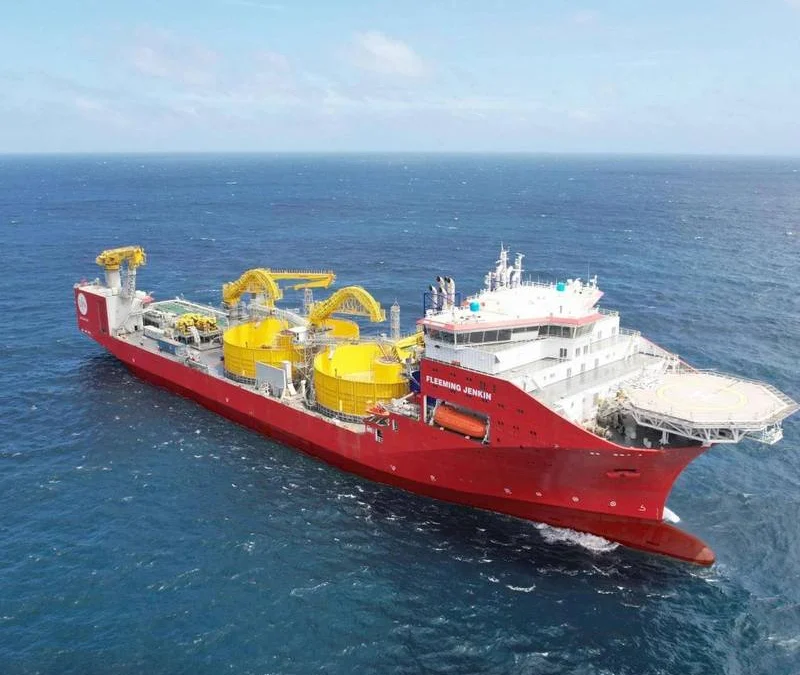
Demand for subsea power and telecom cable construction is driving a larger fleet of purpose-built cable-laying, maintenance, and repair vessels (via www.marinelink.com).
Jan De Nul is set to introduce the 215-meter Fleeming Jenkin, which has a 28,000-ton cable load intake and can operate on methanol fuel.
Jan De Nul’s Fleeming Jenkin enters the lineup
The Fleeming Jenkin is the first of two sister ships ordered from China Merchants Heavy Industry’s Haimen yard. It is designed to work in shallow and ultra-deep waters down to 4,000 meters and to support HVDC cable bundling in a single operation.
The ship’s machinery package has a maximum combined output of 30,600 kW and can run on methanol, biodiesel, HVO, or diesel oil. The vessel also includes a 2.5 MWh battery installation for peak shaving, load smoothing, spinning reserve, and optimized engine loading.
The second ship in the class, William Thomson, was put into the water in April 2026 and is expected to enter service by mid-2027.
Other cable layers are filling narrower roles
NKT’s 23,000-ton HV cable newbuild NKT Eleonora is nearing completion in Norway and is due to enter service in 2027. NKT Eleonora will work with the 140-meter NKT Victoria on a project led by TenneT to connect offshore wind farms to the onshore grid.
Global Marine has bought a 128-meter Norwegian cable ship and ordered a 100-meter newbuild from Colombo Dockyard to support long-term telecoms cable maintenance work. The new Global Marine ship will carry 1,800 tons of cable storage and is expected to be delivered in the fourth quarter of 2029.
OMS Group has four new cable layers under construction in response to stronger demand from the telecoms industry. The company contracted two cable ships from Ulstein, and the pair will collectively form the Great-class.
The Royal IHC Group’s Type 22-based cable ships each have an aggregate cable capacity of 6,500 tons and dual firing lines for lay and maintenance operations. The vessels also include plough trenching and cable burial capability to a depth of 3.3 meters, with deliveries planned for 2027 and 2028.
The two Ulstein-built ships each have a maximum intake of 6,500 tons of fiber optic cable and use the SX252 design with an X-Bow configuration.
Nexans Electra was commissioned in May 2026 and has 13,500 tons of total cable capacity on three turntables. It can lay up to four cables simultaneously and uses a hybrid power system with five Bergen main gensets.
Prysmian Group received a cable burial tool in July 2026 for use on Prysmian Monna Lisa and Prysmian Alessandro Volta, and the tool can bury cable up to five meters below the seabed.
LS Marine Solution’s 148-meter newbuild at Tersan Shipyard is scheduled for completion in the first half of 2028 and will handle high-voltage AC, high-voltage DC, and fiber optic cable.
LS Cable & Systems is expanding LS Greenlink, its U.S. submarine cable manufacturing subsidiary on the Chesapeake Bay waterfront in Virginia.
Droam Perspective
For subsea cable buyers and cable-lay contractors, the fleet buildout is not abstract: the disclosed vessels are getting bigger, more specialized, and more focused on fewer but larger jobs. The terms here point to a market where load intake, burial depth, fiber capacity, and multi-cable lay capability are becoming the procurement differentiators.
That matters because the list is no longer just about one shipyard or one owner. Jan De Nul, NKT, Global Marine, OMS Group, Royal IHC, Ulstein, Nexans, Prysmian, and LS Marine Solution are all adding capacity aimed at different slices of the subsea market.