
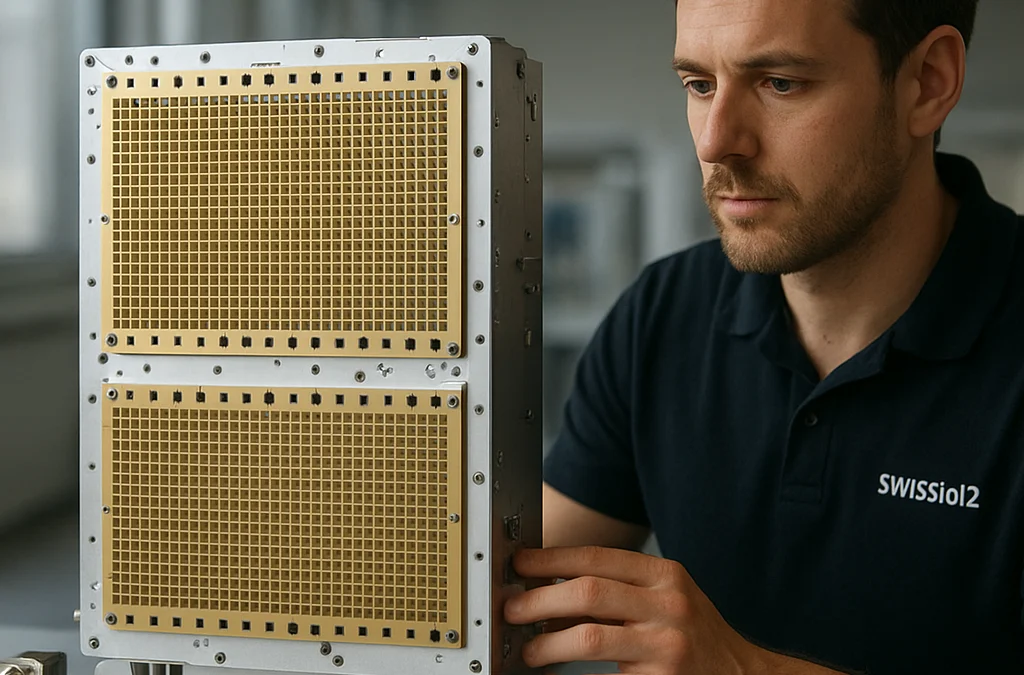
SWISSto12 completed the Critical Design Review for dual-band S- and Ka-band active phased array antennas intended for UNIVITY’s 5G non-terrestrial network demonstration satellites. The milestone clears the antenna subsystems for flight hardware production (via satnews.com).
That work sits inside UNIVITY’s uniShape demonstration initiative, backed by the French Space Agency and the France 2030 investment plan. The mission targets a shared, neutral-host orbital infrastructure in very low Earth orbit that would let commercial telecom operators deploy branded 5G broadband and direct-to-device coverage using their existing terrestrial spectrum allocations.
Antenna scope and operating bands
SWISSto12 manufactures the dual-band antenna suite at its facility in Switzerland under its HummingLink product line. The S-band direct radiating array is engineered for direct-to-device connectivity to link unmodified commercial 5G smartphones directly to orbital nodes, while the Ka-band direct radiating array operates at 26 GHz to deliver high-capacity user broadband services and feeder links.
The company also uses proprietary 3D printing to fabricate passive radiating front ends with integrated miniaturized low-loss filters, paired with in-house beamforming printed circuit boards and digital control electronics.
From design review to flight hardware
UNIVITY previously launched its initial regenerative 5G payload aboard an orbital transfer vehicle. The CDR result now moves the program into flight-model assembly and environmental acceptance testing ahead of UNIVITY’s planned prototype satellite launches.
Emile de Rijk, CEO and founder of SWISSto12, said reaching Critical Design Review in less than one year was possible because of the company’s proprietary payload and antenna technology and vertically integrated delivery model. He said the program is entering the next phase of hardware production and an extensive verification and acceptance campaign.
Droam Perspective
For satellite networking teams and telecom planners, the disclosed architecture is the point to watch: UNIVITY is tying a neutral-host orbital layer to operators’ existing terrestrial spectrum rather than to a one-off proprietary network. That makes the program a test of whether the same spacecraft bus can support both satellite broadband and direct-to-device service without changing the operator’s spectrum position.
SWISSto12’s role is narrower but still material: the company has moved the antenna package past design validation and into flight-model work. The next proof point is whether the hardware and acceptance campaign hold up through prototype launches.