
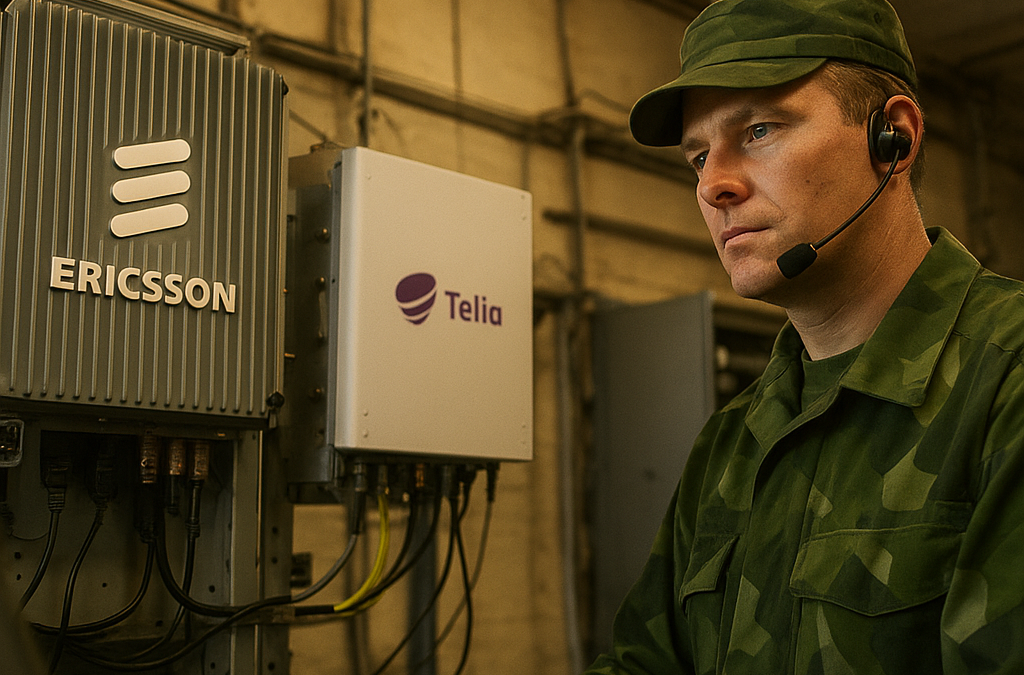
Sweden’s armed forces will use 5G for military communications on Telia’s nationwide commercial network, with Ericsson as the infrastructure vendor. The Swedish Defence Materiel Administration is supporting the program, which covers military capabilities as well as communications (via www.telecomstechnews.com).
The rollout covers military bases, temporary field solutions at unit locations, and emergency airbases. The equipment can also be mounted on moving military assets including amphibious craft, frigates, and transport aircraft, while the armed forces say the new capability complements existing military communication systems rather than replacing them.
Military deployment scope and operational use
The announced 5G setup is not a lab-only test. It is meant to work across fixed sites, temporary field locations, and moving platforms, which gives Sweden a communications layer that can follow the unit instead of staying tied to a base network.
NATO’s role in the program
The Swedish government has tasked the armed forces with establishing an innovation platform to develop and evaluate next-generation wireless networks under NATO’s Rapid Adoption Action Plan. NATO has also entrusted Sweden and Finland with leading future military wireless communications through its Innovation Range initiative.
At the announcement, attendees saw a live demonstration of Ericsson’s drone detection on the integrated sensing and communication capabilities of 5G. Ericsson said selected small-scale, sensing-only commercial pilots are expected to begin in 2027, with wider-scale sensing deployments to follow in 2028.
What it means for U.S. buyers
For U.S. public-sector and critical-infrastructure buyers, the key decision is whether cellular networks can support mission communications without displacing existing systems. Sweden’s program keeps 5G as a complement, not a replacement, and it extends that use case from fixed bases to temporary sites and mobile assets.
Droam Perspective
For defense and critical-communications buyers, the more interesting signal is that Sweden is tying commercial 5G to a formal military innovation track rather than treating it as a one-off deployment. Ericsson’s 2027 and 2028 sensing timeline gives competitors a commercial benchmark, while the NATO link makes the program more about capability development than simple network modernization.