
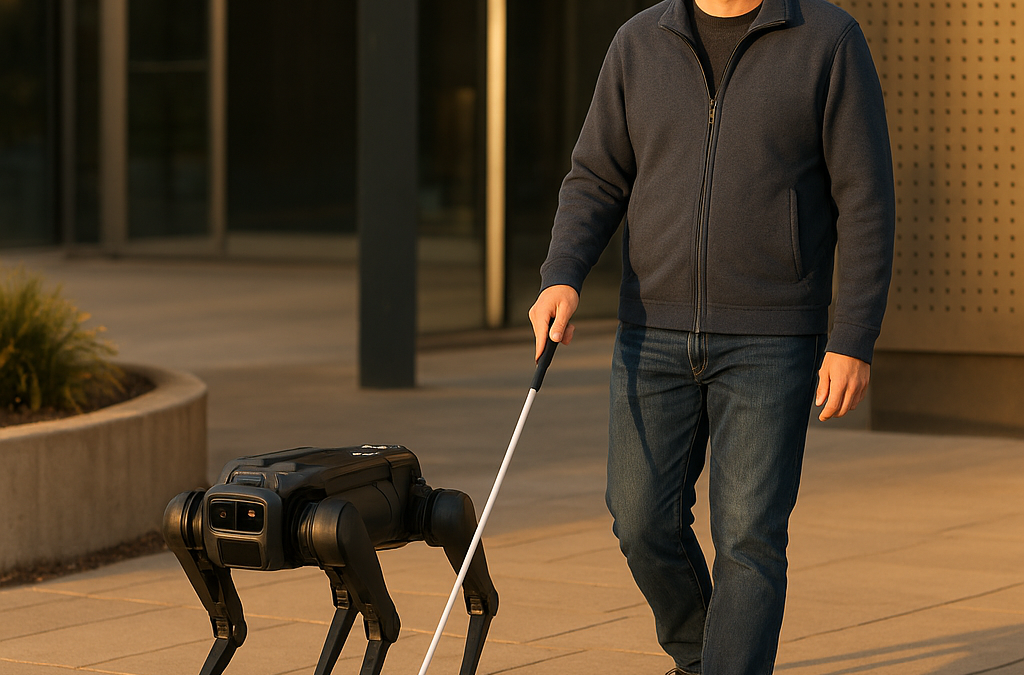
Netcracker says physical AI is moving beyond digital assistants into autonomous robots, intelligent machines, and spatial computing systems. In an interview at DTW Ignite 2026, the company pointed to its Catalyst project as a demonstration of edge-based AI workloads for real-time physical AI applications.
John Byrne, Netcracker’s Director of Market Strategy, said public forecasts project the global physical AI and edge AI market to rise from roughly $7.9 billion in 2026 to more than $110 billion by the mid-2030s. He also said CSPs that stay on connectivity alone risk being sidelined.
What Netcracker says its Catalyst project demonstrated
Netcracker’s Catalyst project is called Robotic Dog: AI at the Edge, Sustainable Revenue at Scale. The project showed a visually impaired person being guided safely through indoor and outdoor environments using real-time sensing, obstacle avoidance, voice interaction, route planning, and edge-assisted perception.
The same project showed compute-intensive tasks such as real-time perception fusion, continuous environmental mapping, and complex AI inferencing being offloaded from physical devices to CSP-controlled distributed edge nodes. Byrne said that setup supports dynamic AI-as-a-Service models rather than static data plans.
Netcracker’s monetization stack
Byrne said operators can charge robotics OEMs and enterprise fleet managers for hosted foundation models, real-time contextual awareness, and guaranteed low-latency closed-loop execution. He also said CSPs can provide AI lifecycle management, contextual data fusion, policy orchestration, and guaranteed service-level agreements for safety-critical inferencing.
Netcracker’s Open Management Platform provides BSS/OSS scaffolding to manage, orchestrate, and monetize multi-vendor physical AI environments. Byrne said CSPs can use TM Forum Open Digital Architecture and Zero-Touch Partnering frameworks to track multi-party usage and settle transactions in real time.
Signal for CSPs evaluating physical AI business models
The pricing unit in this framing is not just bandwidth. Byrne said token-aware charging can meter and monetize input and output tokens, GPU cycles, and contextual inferencing calls at the edge.
For operators building around edge compute and physical AI, the claim set points to a commercial model built around hosted workloads, assurance terms, and partner settlement rather than connectivity alone. The figures Byrne cited also suggest why vendors are trying to anchor this discussion now, even if the market is still early.