
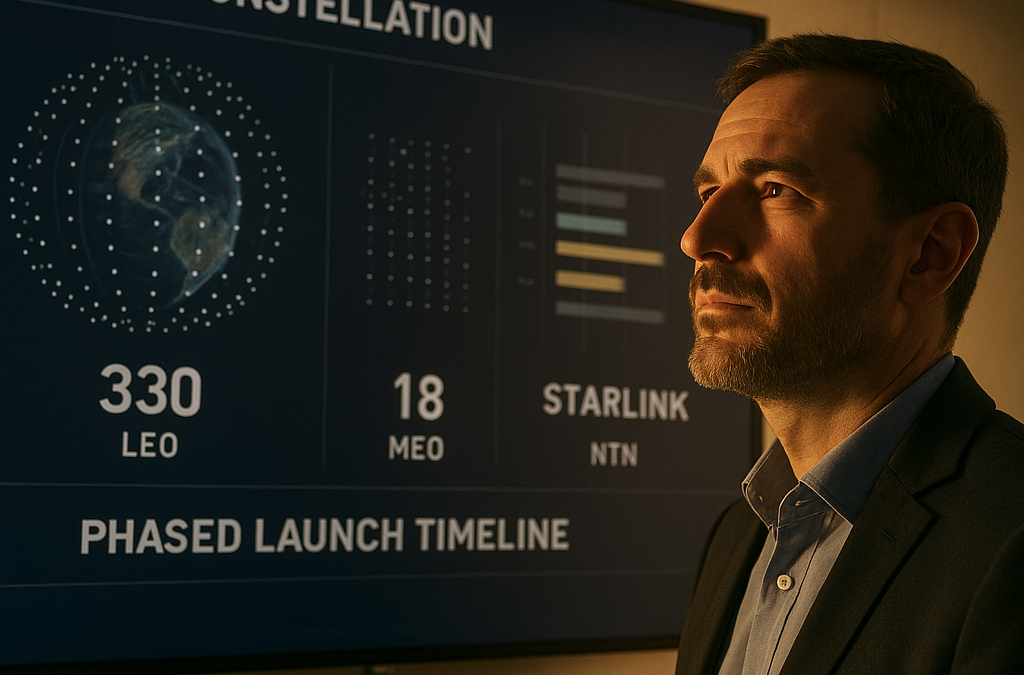
The European Commission and the SpaceRISE consortium revised the IRIS² schedule, bringing the phased launch of 330 LEO satellites and 18 MEO satellites forward to 2029. At the same time, Starlink reported $4.3 billion in revenue last quarter and said it is targeting a tenfold increase in its direct-to-device satellite fleet by the end of 2027.
What changed in IRIS²
IRIS² is the European Union’s sovereign satellite communications infrastructure project. The updated plan adds 66 higher-LEO satellites for defense, security, and emergency services, pointing the constellation toward a support role rather than a direct consumer fight with terrestrial networks.
SpaceRISE is led by SES and supported by Eutelsat and Hispasat. The schedule revision moves the project onto a tighter timetable, with the phased launch now set for 2029.
Starlink’s satellite and spectrum push
Starlink increased its spectrum capacity by 13 times, from 5 MHz through telcos to 70 MHz including its own spectrum. The analysis also ties that to 65 MHz of AWS-3 and AWS-4 spectrum from EchoStar in late 2025.
Starlink added 1.7 million net new users last quarter, and revenue rose 66% year over year. SpaceX says Starlink remains its largest and only profitable business.
What this means for satellite connectivity buyers
For satellite connectivity buyers, the useful signal is not just capacity growth but the mix of public-sector and commercial buildouts now moving on parallel tracks. IRIS² is being shaped around defense, security, and emergency services, while Starlink is pushing D2D scale and more spectrum into the same broader NTN conversation.
That leaves procurement teams, integrators, and policy watchers with two different models to benchmark: a sovereign European program with a revised 2029 ramp, and a commercial D2D operator extending capacity and satellite count at pace.