
Mobile World Congress Shanghai 2026 opened with the GSMA’s IQ era pitch landing in China’s telecom sector. GSMA director general Vivek Badrinath said the framework, unveiled earlier in 2026 at MWC Barcelona, gives telcos a new opportunity to use AI to connect and coordinate intelligent systems at scale.
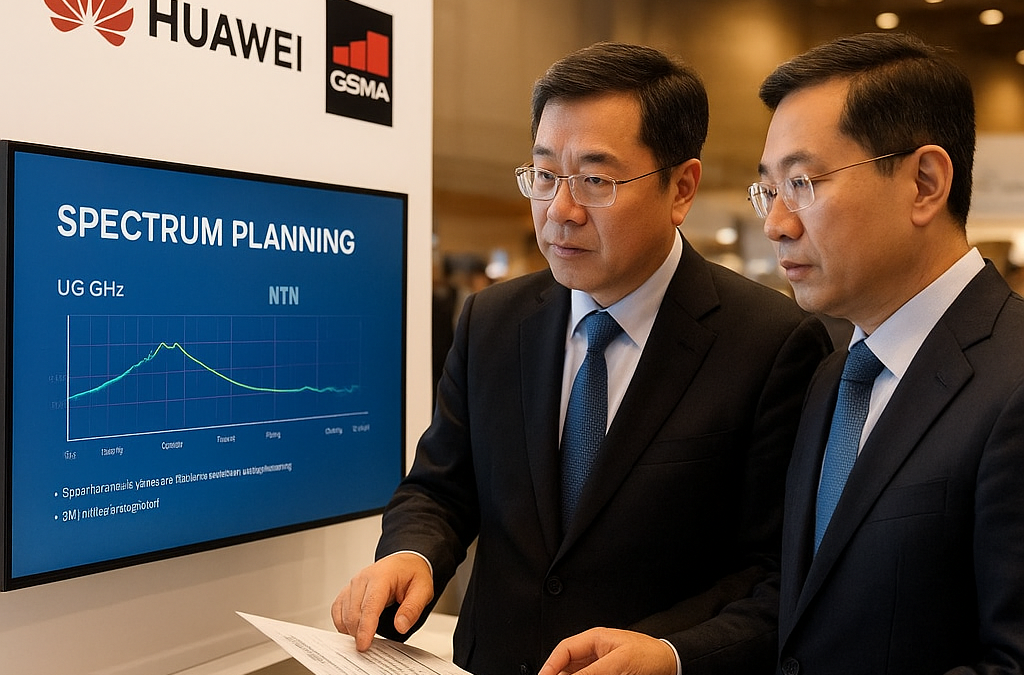
That argument was paired with a more familiar carrier ask: spectrum. Huawei executive Wang said operators need at least another 200 MHz to 400 MHz of continuous large-bandwidth spectrum as a future capacity layer, with the upper 6 GHz band, specifically 6425-7125 MHz, likely to supply it.
AI for systems that act, not just connect
Badrinath said the IQ era is about systems that sense, decide, and act in the real world across cities, infrastructure, and economies. China Mobile chairman Chen Zhongyue also said the upcoming era of mobile AI requires all players to explore broader and new fields of intelligent services to make mobile and AI more inclusive.
Huawei’s spectrum case goes beyond 5G capacity
Wang tied the capacity request to a wider network agenda. He said refarming and aggregating legacy spectrum would also help, and described 2026 as a critical year for the industry.
He also called for promotion of U6 GHz, identification of more bands to expand capacity, industrial development of NTN, deployment of AI-native core network architectures, and new business models that integrate business networks with mobile services. Wang said space-ground integrated services will create new business paradigms and models, with coverage becoming an operable asset.
What this means for spectrum planners and NTN teams
The practical signal is simple: the Chinese carrier and vendor pitch is no longer limited to AI branding. It now comes with a specific spectrum ask, a named band, and a push for NTN and AI-native core architecture in the same conversation.
For operators, that makes U6 GHz and legacy refarming part of the same planning frame as mobile AI. For equipment and policy teams, it turns spectrum harmonisation and NTN support into near-term coordination topics, not abstract 6G talking points.