
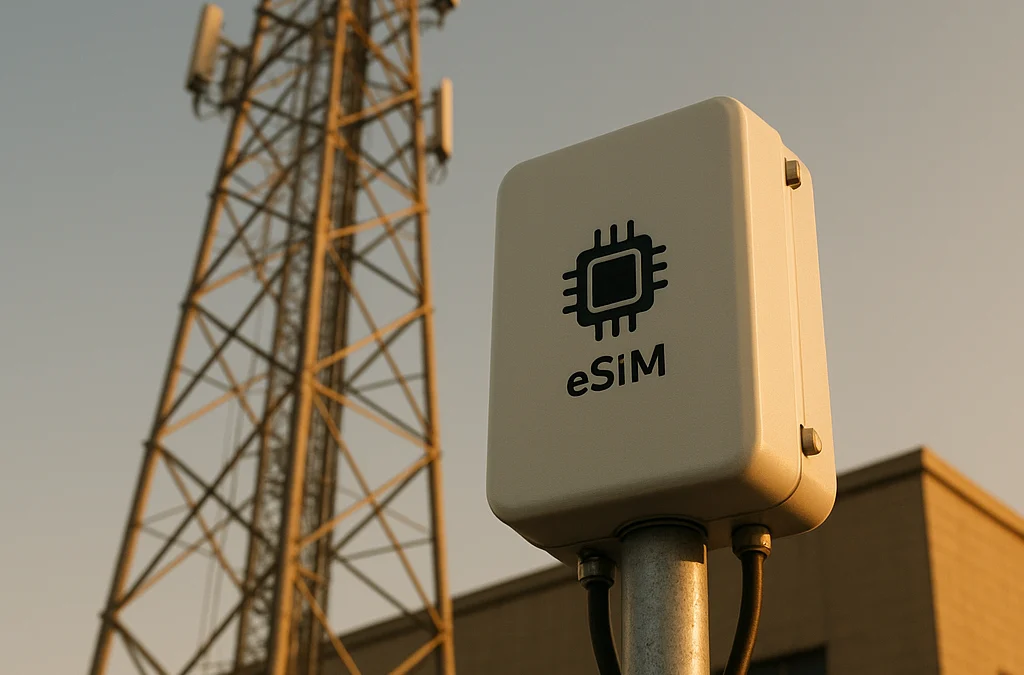
Thales and BR Captura have published a joint paper arguing that the SGP.32 eSIM standard could give businesses greater control over IoT & M2M connectivity in Brazil and wider Latin America. IoT Now describes the document as a joint perspective that examines remote profile management alongside the operational considerations of managing connectivity as requirements change (via iotinsider.com).
Remote profile changes replace a fixed SIM identity
With traditional SIM cards, the operator identity is generally fixed for the useful life of the card. eSIM allows operator profiles to be securely downloaded, activated and managed remotely on compatible devices and modems.
The paper explores how organizations could adapt connectivity as coverage, service quality and commercial conditions change, without physically replacing SIM cards across large fleets of deployed equipment. The paper suggests the standard could have implications across payment services, tracking and logistics, utilities, security, healthcare, agriculture and industrial applications.
The utility example: public cellular first, private later
The paper uses utilities as its example of how this flexibility could work. Utility operators could begin deployments on public cellular connectivity and later migrate devices to private infrastructure as coverage becomes available.
Rafael Jaccoud Costa, Director of New Business LATAM at Thales and one of the paper’s authors, said: “You do not need to wait for a private network before deploying a meter.”
How fallback profiles let devices use a backup network
The companies argue that the value of SGP.32 depends on combining remote profile management with an orchestration system that makes connectivity decisions based on operational requirements. Where a private network is the primary connection, a public operator profile could remain available as a backup, and configured profile fallback could let devices use an alternative network when the primary connection becomes unavailable.
Does switching the operator profile stop billing on the old subscription?
IoT Now reported that changing the active operator profile does not automatically terminate the commercial relationship with the previous profile, and that the subscription may remain active and billable. The same outlet listed the steps the joint perspective highlights: understanding the installed fleet, checking device and modem compatibility, aligning deployment with renewal or recommissioning cycles, preparing logistics and billing processes, and establishing governance for larger multi-profile deployments. IoT Now also reported that Thales supplies the standards-based environment and interfaces used to manage eSIM profiles remotely, while BR Captura supplies an orchestration layer connecting operator choices with customer-defined business rules, inventory, subscriptions and cost management.
Droam Perspective
For IoT fleet operators and utilities, the paper’s example of starting on public cellular and later migrating devices to private infrastructure describes one specific deployment path. Because changing the active operator profile does not automatically end the previous commercial relationship, a subscription may stay billable after a device moves to a different profile. Configured profile fallback could let a device use an alternative network when its primary connection becomes unavailable, as the paper describes.