
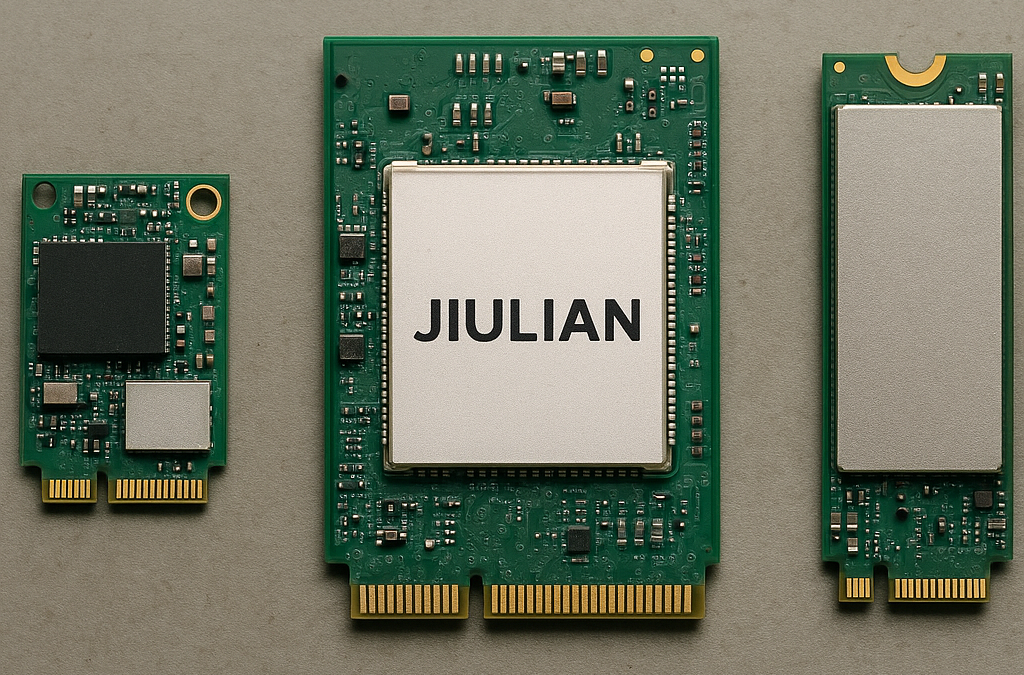
Jiulian IoT has launched a new line of 5G modules for business-to-business connectivity. The lineup also includes NB-IoT and LTE options, and Jiulian says the modules are aimed at dispersed, power-hungry, or difficult-to-connect equipment.
The product is being positioned for industrial integration rather than a single use case. Jiulian offers the modules in LCC, LGA, Mini-PCIe, and M.2 formats, and says they are designed to make integration with common chipset platforms easier.
Radio mix and industrial formats
Jiulian’s architecture separates roles across the radio stack. NB-IoT is for low-power sensors, 5G is for more demanding needs, and LTE remains in the line for established fleets.
The modules are also available in LCC, LGA, Mini-PCIe, and M.2 industrial formats. That gives the line a set of integration options across existing hardware designs.
Target equipment and certifications
Jiulian targets video surveillance, meters, and alarms with its connectivity products. The company says it has certifications covering automotive quality and information security.
Those details matter because the announcement is not just about radio support. It also ties the product line to the kind of deployment checks that buyers usually ask for before they slot a module into a fleet.
RedCap volume outlook
ABI Research forecasts 80 million RedCap modules will be shipped from 2024 to 2029. The same study says eRedCap would account for 71% of that volume.
That forecast puts the RedCap family in the center of the low-power 5G module discussion, with eRedCap carrying most of the expected shipments in the study’s model.
What this means for IoT module buyers
For module buyers, the notable detail is the combination of three radio options, four industrial form factors, and stated certifications in one product line. The practical benchmark here is whether competing module vendors can match that spread without forcing a redesign.
System integrators will also read the RedCap forecast as a sign that low-power 5G hardware is moving deeper into the module conversation, even if this Jiulian launch itself stays at the product level.