
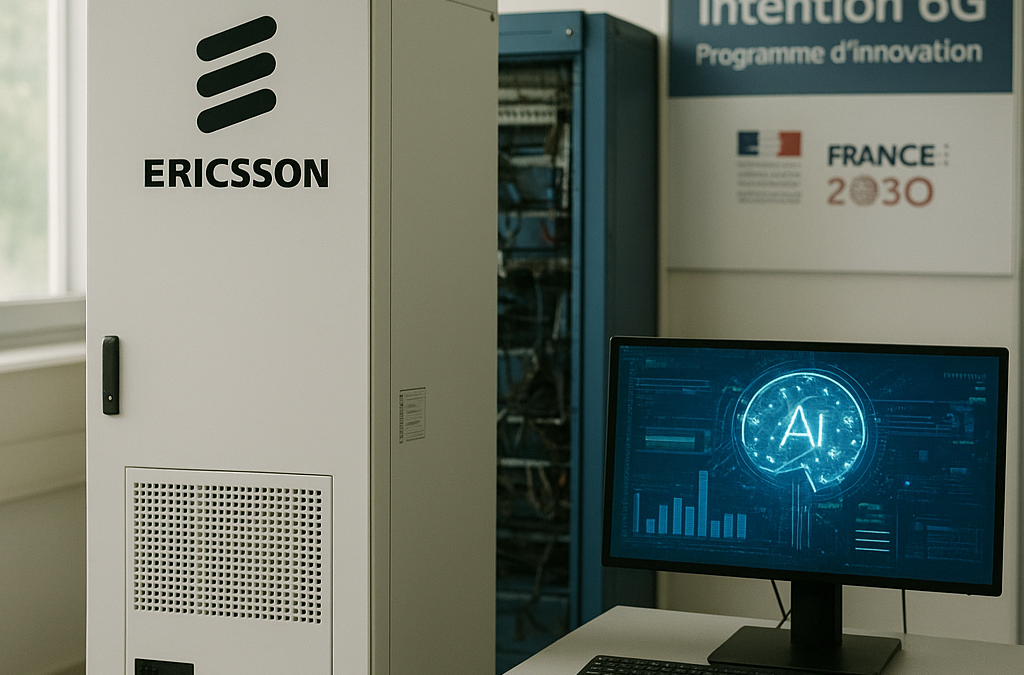
Ericsson says its work to optimise RAN energy consumption under the Intention 6G programme is at a mid-point, as the vendor pursues €12 million of funding linked to France 2030 decarbonisation targets.
The same research effort is described as aiming for optimal RAN energy use while still meeting the needs of 5G and 6G traffic, with AI used to automate functions and manage dynamic energy consumption.
Intention 6G shifts from optimisation status to defining “building blocks”
Ericsson frames the programme as moving through a lifecycle: with the mid-point reached, it says the focus of Intention 6G is switching to defining the initial “building blocks”.
In its description of the initiative, the vendor links the decarbonisation rationale to France 2030, and says the work is intended to keep the network’s energy footprint in line while still serving both current 5G demands and 6G traffic.
Funding and structure: €12 million, co-funded by Bpifrance
Ericsson positions Intention 6G as a France 2030-aligned move worth €12 million, and says the initiative is co-funded by domestic bank Bpifrance.
France 2030 is described as a €54 billion investment programme covering decarbonisation through technological innovation and promoting companies in key industrial sectors.
Ericsson also says its research programme demonstrates the benefits of broad collaboration through public-private partnerships.
AI-led mechanisms for RAN energy adaptation
Ericsson says AI is central to the Intention 6G work, including automating network functions and managing dynamic energy use.
The vendor also describes developing infrastructure that can adapt power consumption by itself, connecting that capability to the programme’s objective of optimising RAN energy use under real operating needs.
Christian Leon: French R&D collaboration for critical use cases
Christian Leon, head of Ericsson Western Europe, said the project shows how Ericsson’s French R&D centre is collaborating with domestic companies to develop networks for tomorrow’s critical use cases and digital transformations.
Separate signal: standalone 5G trial at Japan’s Suzuka race with SoftBank
On 17 June, Ericsson separately detailed a trial of standalone 5G conducted by its Japanese unit with SoftBank Corp during the FIA Formula 1 Grand Prix at Suzuka Circuit in March.
Ericsson says the trial used five independent network slices, including one involving mmWave to boost connectivity at the venue, and that the setup enabled quality to be optimised for specific use cases.
The vendor also says Ericsson Japan and SoftBank deployed tri-band Massive MIMO equipment and various mmWave radios, and conducted “detailed network design”.
Ericsson reports the trial increased downlink data rates by 4.1 times and uplink data rates by 14.6 times for SoftBank users who received the service at the event in 2025.
It further says some base stations used self-tuning to adjust the performance of individual network slices based on a quality measurement taken every minute.