
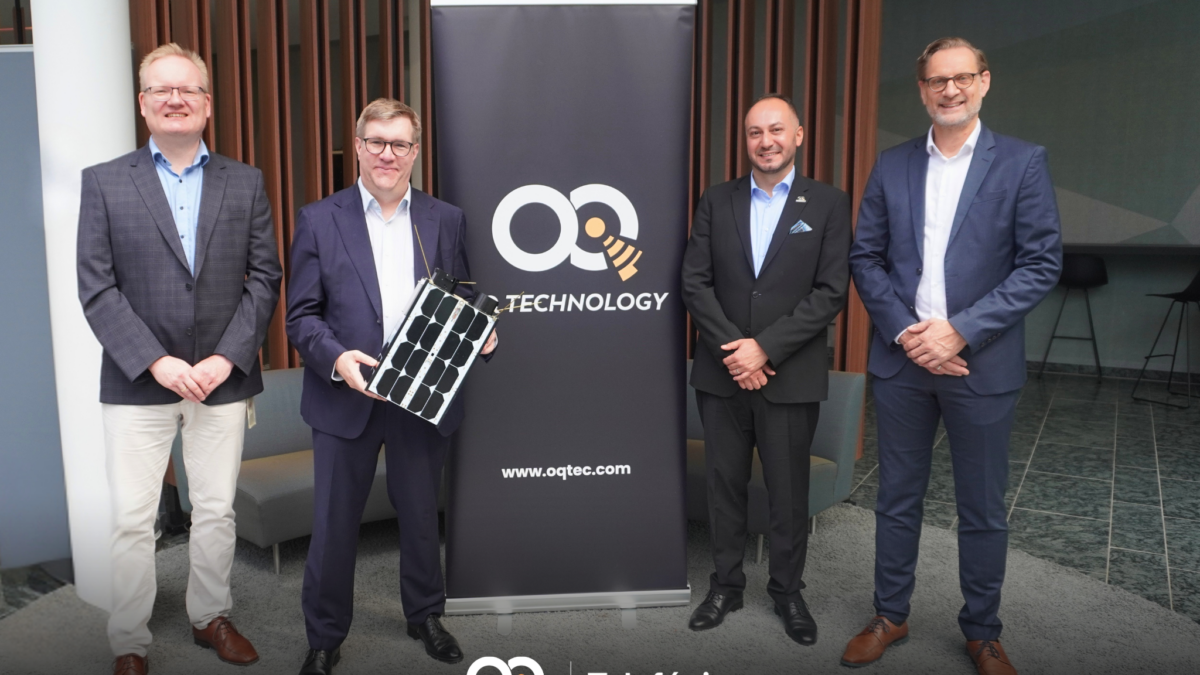
OQ Technology will test direct-to-smartphone satellite connectivity in Germany next year using Telefonica Germany’s cellular spectrum, with the trial centered on the operator’s 2.6 gigahertz band.
Telefonica Germany announced a June 8 partnership with OQ Technology to demonstrate two-way messaging and voice capabilities between a small satellite slated for a 2027 launch window and unmodified smartphones.
Two-way D2D trial timing, architecture, and target use case
The demonstration is scheduled to use a small satellite slated to launch in the first half of 2027. The planned test area is Mecklenburg-Western Pomerania in northeastern Germany, and OQ Technology’s plan is to use only one satellite to cover the sessions as it traverses the region.
OQ Technology says the setup is meant to be sufficient to test short communications sessions, including a potential five-to-10-minute emergency voice call beyond terrestrial coverage. Omar Qaise also said messaging could be established immediately because of a nearby gateway, while adding that a single satellite would likely deliver only around two passes per day over the same area at best.
Why cellular spectrum and what the 2.6 GHz test is supposed to answer
The Germany test specifically uses Telefonica Germany’s 2.6 gigahertz spectrum, which Omar Qaise described as part of a mid-band mobile allocation also used widely elsewhere for terrestrial communications. Qaise said the trial is intended to generate information about coverage, managing interference, and optimizing the service for regulators and mobile operators.
OQ Technology also framed the data as input into how it might expand direct-to-device services via cellular frequencies in the future.
Positioning against other D2D efforts and the European S-band policy backdrop
OQ Technology said the trial is intended to follow SpaceX’s early direct-to-device progress using cellular spectrum from partners across multiple countries, where SpaceX connects smartphones via around 650 specialized Starlink satellites. SpaceX received permission to trial its Starlink Mobile service in Spain, and it has partnered with Deutsche Telekom to provide next-generation direct-to-device services in 10 European countries from 2028 after launching upgraded satellites.
At the same time, the Europe-to-mobile-direct connectivity race is being shaped by spectrum access. The European Commission moved to reshape access to another part of S-band after current authorizations expire in 2027, proposing to split the band into three blocks, with only one block open to operators outside Europe. The proposal includes one third set aside for government communications linked to IRIS², with another third open only to European entrants and the remainder open to European and non-European operators.
From smartphone trials to S-band IoT and defense use
OQ Technology’s cellular direct-to-device trial builds on earlier spectrum tests. Last year, it transmitted a test emergency broadcast message to unmodified smartphones using satellite S-band spectrum, and it said its low Earth orbit constellation currently uses S-band to connect proprietary and mass-market internet of things tracking and monitoring devices.
The company is already planning further in-orbit work: it plans to deploy a dedicated S-band spacecraft for direct-to-device in 2027 to further test capability with unmodified smartphones, and it plans to test smartphone connectivity with a separate satellite using C-band later this year. Qaise said OQ Technology’s network is designed to complement terrestrial mobile networks, extending coverage while preserving terrestrial mobile operator control and their spectrum sovereignty.
OQ Technology is also pursuing defense-adjacent applications for its constellation, including drones. It said it recently used S-band spectrum from space to transmit video from a compact drone, using edge computing to compress footage to fit in a narrowband internet of things satellite link and avoid the need for larger and more power-hungry broadband satellite terminals.
Earlier this month, Luxembourg’s government awarded OQ Technology €2.28 million (about $2.63 million) for Sentinel, a project with the University of Luxembourg to protect 5G satellite uplinks against jamming, spoofing, and electromagnetic attacks. OQ Technology said the contract is its first major defense award.