
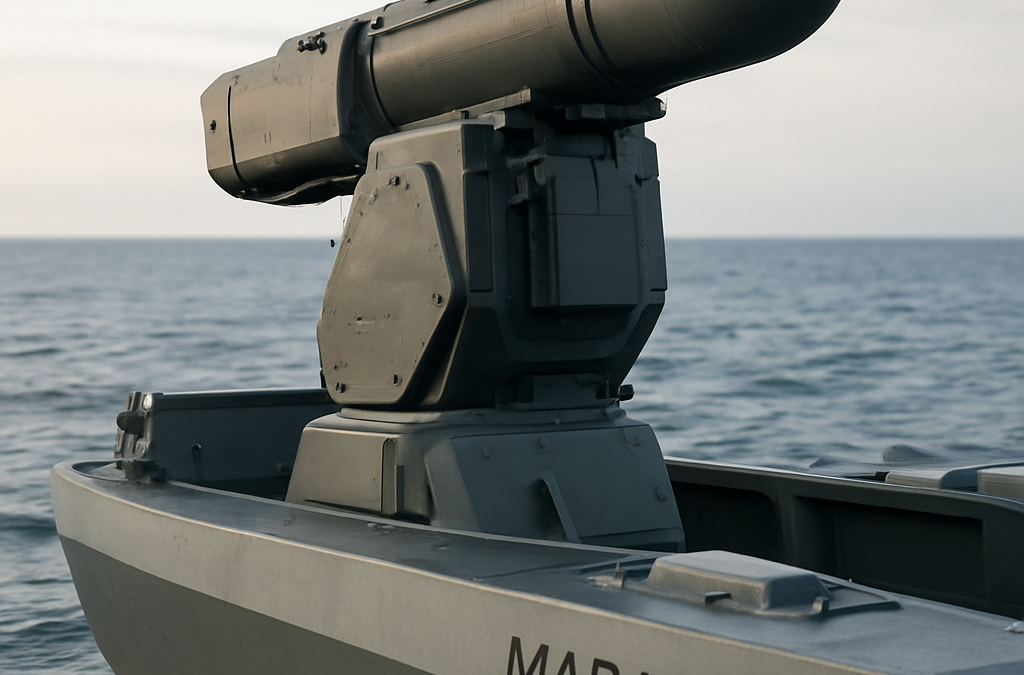
Saronic and Castelion have announced plans to join forces to launch a hypersonic vehicle from an unmanned surface vessel, with Castelion’s Blackbeard integrated into Saronic’s Medium Unmanned Surface Vessel (MUSV) Marauder and a target demonstration set for 2027.
The companies frame the concept as a step toward distributed hypersonic capabilities, combining autonomous surface vessels with hypersonics to expand options for where, when, and how launches can be carried out.
How the MUSV Marauder and Blackbeard integration is supposed to work
Castelion’s Blackbeard is to be integrated with Saronic’s Medium Unmanned Surface Vessel (MUSV) Marauder, turning the ship platform into the launch-adjacent element of the overall system.
The collaboration represents the first integration of autonomous surface vessels with hypersonics, positioning the unmanned platform role as part of the hypersonic delivery chain rather than a supporting, standalone mission.
Targeting 2027 with at-sea flight-test cadence and risk reduction
Saronic and Castelion are targeting a demonstration in 2027, and the path to an at-sea launch depends on moving beyond land-based ranges and crewed maritime assets to accelerate flight-test cadence.
In late 2025, Saronic supported a Castelion Blackbeard flight test by operating the 24-foot ASV Corsair as an autonomous at-sea telemetry collection and communications node. The two teams say they are advancing joint risk-reduction efforts to support continued flight-test operations and build toward the 2027 maritime launch demonstration.
Distributed launch rationale: more platforms, more magazine depth, more options
Hypersonic systems launched from unmanned platforms are positioned as a way for commanders to generate credible strike capacity without relying only on scarce, expensive crewed launch assets.
Distributing launch across a larger number of lower-cost platforms is said to increase magazine depth, create more operational flexibility, and present adversaries with more launch locations, trajectories, and timing challenges, while also making hypersonic forces harder to predict, harder to suppress, and easier to scale.
Production and scaling claims: Blackbeard output and two Saronic buildouts
On scaling, Castelion says it is expanding production capacity to several thousand Blackbeard missiles annually. Castelion’s Project Ranger campus is described as a 1,000-acre hypersonic manufacturing facility in New Mexico, backed by more than $250 million in private capital.
Saronic, meanwhile, is executing a $300 million shipyard expansion in Louisiana that will add 300,000 square feet of production capacity and is expected to be complete by the end of 2026. That expansion is expected to provide the capability to deliver 20 Marauders annually.
Saronic’s Austin, Texas facility adds 400,000 square feet of production capacity and is built to produce thousands of small autonomous surface vessels per year, while Port Alpha is described as the foundation for American shipbuilding.
Together, the companies describe their investments as charting a path for the U.S. and its allies to field the combined capability at the scale and speed of relevance.